
PerfHr journal essay
Stability vs Role Criticality: A Retention Map for Operators
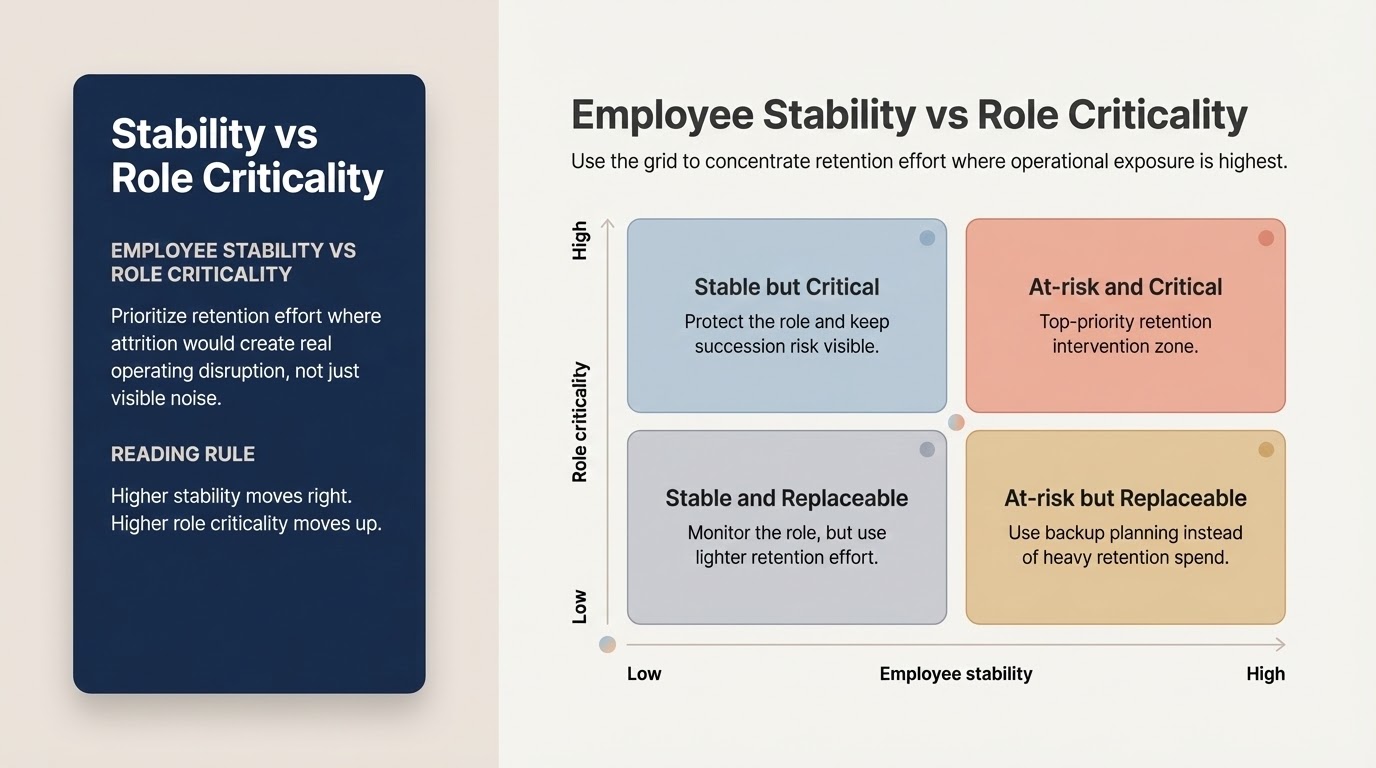
A stability vs role criticality map helps operators see where attrition risk can disrupt service, revenue, or execution. It is a practical retention tool when leadership needs to prioritise quickly.
Diagnostic intent
What Employee Stability vs Role Criticality Matrix is really for
A matrix becomes dangerous when leaders treat it like a judgement board rather than a decision aid. The purpose of Employee Stability vs Role Criticality Matrix is not to compress people into neat labels; it is to help managers look at two forces at the same time and respond with more precision. Without that two-axis view, leaders often overreact to one signal and miss the structural risk sitting next to it.
In most businesses, the pressure to simplify talent decisions is high. Teams want a quick answer about who to back, who to coach, who to redeploy, or where risk is building. The matrix is useful precisely because it slows that rush down just enough to force a more disciplined diagnosis. It makes leaders state what they are measuring, how they calibrated the axes, and what management action logically follows from the combination they are looking at.
That is why the matrix should never stand alone. It belongs inside a broader management rhythm that includes evidence, manager notes, context on role criticality, and a visible follow-up path. Used properly, Employee Stability vs Role Criticality Matrix helps leadership move from broad intuition to targeted intervention. Used carelessly, it becomes a pseudo-scientific scorecard that looks rigorous while hiding weak judgement.
Read the axes correctly
How to calibrate Employee Stability and Role Criticality before the matrix is used
The first discipline is scoring consistency. If one manager calls an employee high on Employee Stability because of effort while another does it because of output, the matrix is already unstable. The same rule applies to Role Criticality. Teams need shared criteria, observable indicators, and examples that help managers anchor their judgement to behaviour and evidence rather than personal preference.
The second discipline is time horizon. Some axes can move quickly while others change slowly. If one measure is inherently volatile and the other reflects a longer-term pattern, the leadership team has to acknowledge that in the review. Otherwise people get misread because a short-term dip is treated as a stable condition or a short-term improvement is mistaken for a structural shift.
The third discipline is comparability. A matrix is only useful if the leadership team agrees which roles, functions, or populations should be compared and which ones should not. Comparing field sales, support operations, and product specialists inside one undifferentiated view creates false precision. The better approach is to calibrate within meaningful groups and then read the pattern for what it is actually telling the business.
- Measure stability through tenure signal, intent, engagement, and external pull
- Define criticality through service, revenue, compliance, or knowledge dependency
- Calibrate risk at the team or workflow level, not only at the individual level
Quick diagnostic
Retention map check
Use this quiz to see whether your retention conversations are prioritised by operating risk or by noise.
What should drive retention priority first?
What should be done for stable but critical roles?
Why is the at-risk and critical quadrant so important?
Quadrant logic
What the quadrants mean and why the names are not enough
The matrix is valuable only when the organisation agrees that each quadrant implies a different management response. If the labels are memorable but the actions are vague, the framework becomes decorative. The real work is deciding what the business should do when someone sits in one quadrant, what evidence would justify movement to another, and how quickly that movement should be reviewed.
Stable but critical and At-risk and critical often get the most attention because they are visibly consequential, but leadership teams also learn a lot from the quieter quadrants. A stable low-risk quadrant may be telling you something about role design, weak challenge, or underused capability rather than simple underperformance. An at-risk quadrant may actually expose a management problem upstream rather than an individual problem downstream.
This is where narrative discipline matters. Leaders should describe what the quadrant says about intervention, not what it says about a person's worth. That subtle difference protects quality of judgement. It keeps the conversation focused on evidence, support, capability, role design, and business risk instead of allowing the framework to become a shorthand for permanent labels that are hard to recover from.
- Stable but critical — Roles that are central to execution and currently stable, requiring protection and succession planning.
- At-risk and critical — Top-priority retention cases where attrition would disrupt operations materially.
- Stable and replaceable — Lower-risk roles where resilience is already acceptable.
- At-risk but replaceable — Cases that still matter, but should not distract leadership from more critical exposure.
Management action
What leaders should actually do after the matrix is plotted
Once the matrix is plotted, the next step is not more discussion. The next step is action sequencing. Which people require coaching, which roles require redesign, which risks demand retention action, and which cases should trigger redeployment or deeper investigation? If the framework does not translate into a short list of actions with owners, it is adding analysis without improving the operating response.
Good leadership teams also decide what evidence would prove the action worked. That may be output recovery, stronger engagement, improved skill match, lower attrition risk, or greater role stability depending on the matrix being used. Without that closure condition, the organisation keeps revisiting the same people in the same quadrant with more commentary and no movement.
The strongest operating habit is to treat matrix reviews as portfolio conversations. The question is not only what one manager should do with one case; it is what the pattern is revealing about the bench, the organisation design, the manager population, and the business model. When read this way, the matrix stops being a talent labelling tool and becomes a business risk map.
- Build succession for stable but critical roles
- Intervene immediately on at-risk and critical cases
- Maintain sensible replacement benches for replaceable roles
- Use the map to prioritise leadership attention rationally
Evidence pack
What should sit behind Employee Stability vs Role Criticality Matrix before the room starts debating
A matrix is strongest when it arrives with supporting evidence that keeps the room grounded. That evidence pack should include the scoring anchors, the time period being reviewed, comparable peer context, and any major changes in role scope or manager responsibility. Without that preparation, leaders spend the session arguing about whether the chart is fair rather than using it to decide what to do next.
The evidence pack does not need to be heavy. In fact, too much material often weakens the room because people use extra data to defend pre-existing views. The better standard is concise but decisive: show the measures that justify the placement, add the most relevant manager note, and clarify whether this is a new signal, a repeated pattern, or a movement after intervention. That is usually enough to frame a disciplined discussion.
Good preparation also protects the organisation from political distortion. When everyone knows which evidence is admissible and which is not, the room becomes less vulnerable to anecdote, charisma, or hierarchy. That matters especially in talent discussions, where poorly governed conversations can quickly turn into reputation contests rather than operating decisions.
- Include scoring anchors and time horizon.
- Show whether the case is new, recurring, or post-intervention.
- Use concise evidence that supports action rather than debate.
Interpretation risk
The mistakes that make matrix reviews politically noisy and operationally weak
The first mistake is overconfidence in the scoring. Matrices feel rigorous because the visual is clean, but the underlying judgement may still be rough. If calibration is weak, a polished graphic can make poor reasoning more dangerous rather than less. The second mistake is assuming the matrix explains the cause of a problem when it only locates the problem. Root cause still has to be diagnosed.
Another common error is running the matrix once and treating it like a definitive truth. These views are snapshots inside a moving business. People change, roles evolve, managers improve, and operating conditions shift. Without periodic review, the matrix hardens yesterday's conclusion into today's identity. That is especially risky in growing companies where responsibilities expand faster than job descriptions can keep up.
The final trap is secrecy. Leaders sometimes hide the matrix because they fear the politics of transparency, but that often creates even more speculation. The right answer is not reckless exposure; it is responsible governance. Clarify who sees the matrix, what language is allowed in the room, what evidence sits behind placement, and what actions are acceptable. Governance makes the tool usable.
- Treating every attrition risk as equally urgent
- Confusing role difficulty with role criticality
- Missing team concentration risk when several similar roles are fragile
Use it responsibly
How to socialise Employee Stability vs Role Criticality Matrix with managers without creating label damage
Matrix outputs should not be broadcast as verdicts. The point is to improve judgement and intervention, not to create a second informal performance label that follows someone around the business. Leaders need to decide which audiences see the full view, what language is acceptable when discussing it, and how managers should describe the resulting actions to employees when those actions affect development, support, or retention.
This is especially important when a matrix cuts close to identity or perceived value. Once people believe the framework is being used to brand them rather than help the business respond more intelligently, trust falls sharply. The right safeguard is not secrecy alone. It is disciplined communication: explain that the matrix is a decision aid, define what movement looks like, and connect it to real interventions instead of personal judgement.
Managers should therefore be coached on translation. They may use the matrix in the governance room, but when they speak to employees they should talk about role expectations, support, capability, engagement, and business risk in ordinary language. That translation layer protects the usefulness of the tool while keeping the human conversation grounded and fair.
- Do not turn quadrant placement into an identity label.
- Govern who sees the matrix and what language the room allows.
- Translate outputs into support, development, or retention conversations in plain language.
Monthly cadence
How to put Employee Stability vs Role Criticality Matrix into a real management rhythm
Monthly or quarterly is usually the right cadence for matrix reviews because the conversation is diagnostic and strategic rather than daily. The business needs enough time for interventions to show movement, but not so much time that risk compounds unnoticed. In practice, that means the matrix belongs in a talent and operating governance room with clear pre-read standards and explicit follow-up owners.
A strong cadence distinguishes between update, discussion, and decision. The update is the plotted view. The discussion is the context behind movement. The decision is the action, owner, and next checkpoint. Many organisations blur those steps and spend the whole meeting debating placement. That creates the illusion of rigour while postponing the management action the matrix was supposed to unlock.
If the organisation can maintain that rhythm, the payoff is substantial. Leaders stop treating people decisions as purely anecdotal. Managers get earlier signals on risk, misfit, engagement, and retention. Most importantly, the business becomes more capable of making proportional decisions. Instead of one blunt response for every performance or talent issue, it learns to choose interventions that match the pattern it can actually see.
- Review after resignation spikes, reorganisations, or manager change
- Tie the map to workforce planning and hiring priorities
- Track whether retention actions actually reduce critical exposure